

Graduates of agricultural mechanization met at the Faculty of Technology after more than 42 years
30.03.2026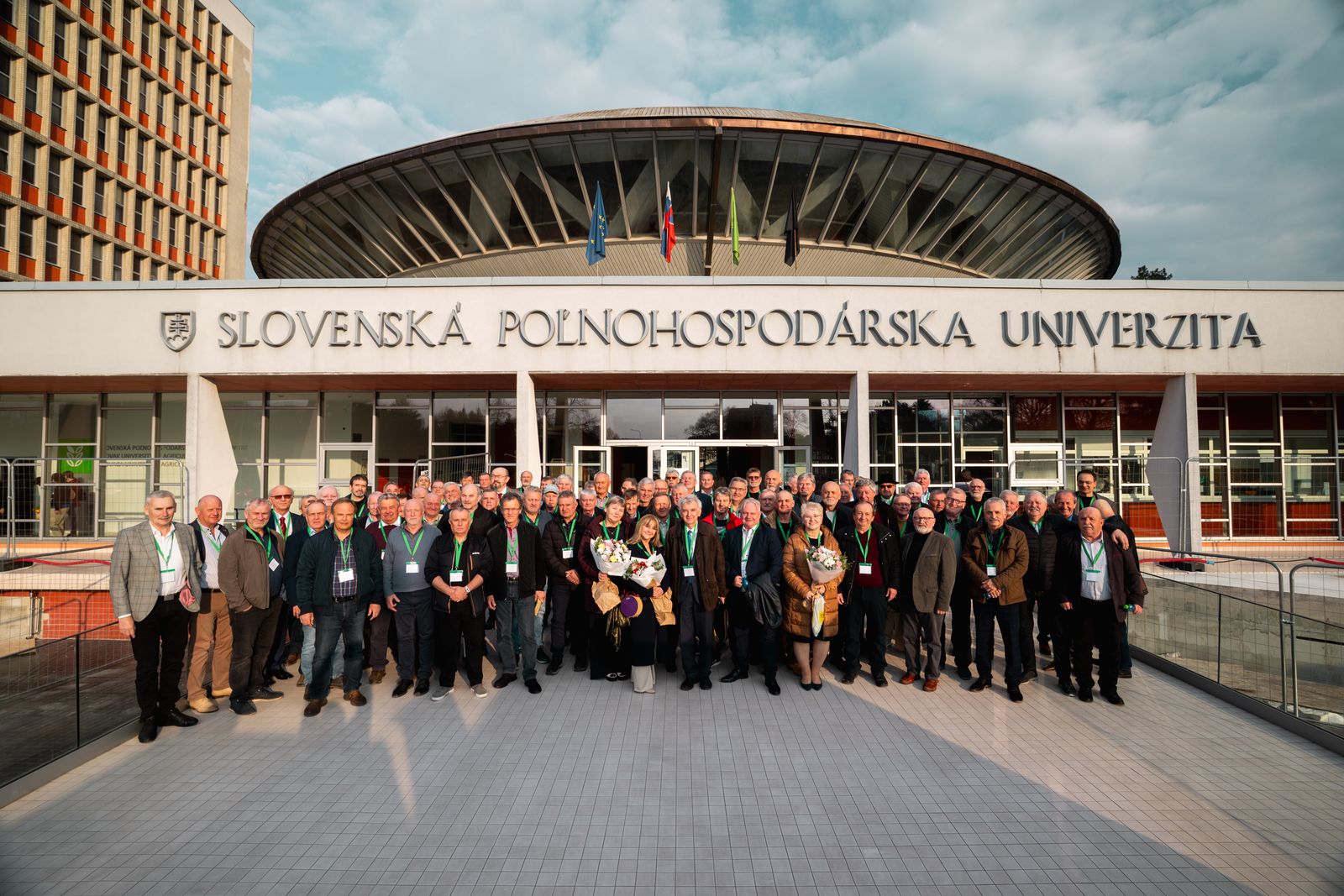
Eighty-three graduates gathered at the Faculty of Technology of the Slovak University of Agriculture in Nitra on March 20 to commemorate their studies at the then Faculty of Mechanization of the University of Agriculture. A total of 164 successful graduates were among the first students of the four-year study at the faculty in 1979–1983 in the field of agricultural mechanization - the only one that the faculty offered at that time.
The participants of the meeting were welcomed at the alma mater by the rector of the Slovak University of Agriculture, Klaudia Halászová. “It is my pleasure to welcome the generation of experts who were responsible for the birth of the current reputation of the Faculty of Technology and the field. The mechanization of agricultural production is generally considered one of the greatest achievements of the 20th century. The university constantly uses your advice and experience. Proof of this is that one of your ranks - engineer Peter Matejovič - is also the chairman of the Board of Directors of the Slovak University of Agriculture,” said the rector.
The graduates had the opportunity to gain insight into current events at the university and learn about innovations, research, professionally oriented study programs, projects, international successes, and infrastructure development. These areas were presented to them by Vice-Rector for Communication and Practice Pavol Findura. The focus of scientific research activities, modernization of education, and the direction of teaching at the Faculty of Technology was presented by its Dean Roman Gálik. According to him, the faculty has so far educated more than 10,000 engineering graduates and currently has approximately 750 students. “In the evaluation of 120 faculties in Slovakia from the perspective of employers, we regularly rank in the top twenty, and in the November evaluation of last year, we took sixth place. The faculty currently offers 12 study programs, and since September, students can also choose from other professionally oriented programs – mechatronics, agriculture and forestry, and process engineer for the automotive industry,” said the dean.
Mechanizers in all corners of Slovakia
The first graduates of the mechanization department found employment across various segments of the economy throughout Slovakia, but primarily in primary production - in agricultural cooperatives and state-owned properties. They also worked in the field of special plant and animal production, commodity processing, service and technical services, but also in state administration, regional development, insurance and education. Some of the graduates also connected their professional careers with the Slovak University of Agriculture. Among them are, for example, engineer Peter Mihaľ, a former university teacher and today a representative of the company Agroservis, engineer Ján Lajda, former managing director of the University Agricultural Enterprise SUA in Kolíňany, or Ivan Vitázek, associate professor at the Institute of Agricultural Technology, Transport and Bioenergetics of the Faculty of Technology.
Engineer Peter Matejovič, director of Ematech and president of the Association of Agricultural Technology Suppliers in Slovakia - Agrion, also has a long-standing cooperation with the university. "SPU and Agrion have intensive cooperation in organizing Technology Days, All-Slovak Field Days and Agrion University. The result of the latest cooperation will be the Innovative Laboratory of Agricultural Technology, which is being created at the university as part of the AgroForestry project. The aim is to provide students with the latest types of agricultural machinery and thus connect study more closely with practice," said P. Matejovič.
Three of the first nine mechanizers, graduates of the four-year study, did not miss the meeting. After completing her studies, engineer Jaroslava Chovanová worked at the PD in Budkovce, later she went to the private company Agrotechna, where she still works as a seller of spare parts and components for Zetor tractors. "The study was demanding, but practice needed us," she said, adding that today agriculture is facing a shortage of qualified "classical" mechanizers. According to her, modern machines require not only knowledge of mechanics, but also knowledge of electronics, hydraulics and information technology. This intermediate step between "classical" mechanics and IT is difficult to fill. "That's why I was very pleased that our faculty reflects modern practice and brings new professional study programs, such as mechatronics. Given the trend of intelligent technologies and electromobility, this is a highly promising field," she stated.
The graduates also welcomed two former teachers among them - Professor Jozef Hrubec and Professor Vladimír Rataj, who currently serves as a member of the Council for the Internal System of Education Quality Assurance at SUA. "It was a very strong year. In 1983, two study programs were completed together - a four-year and a five-year - so approximately 300 mechanical engineers entered practice," said Professor Rataj. He pointed out that all of them found employment and only a small number of graduates found employment outside their field of study. "This also highlights the importance of the profession of a mechanizer and underlines the life experience that a mechanizer could be found in every corner of Slovakia at that time. A local patriot of the Mechanization Company could be found everywhere."
Read more: Graduates of agricultural mechanization met at the Faculty of Technology after more than 42 years